Showing posts with label U.S. dollar. Show all posts

Monday, November 9, 2009

Indicators Flashing 'Sell' for Longer-Term Bonds

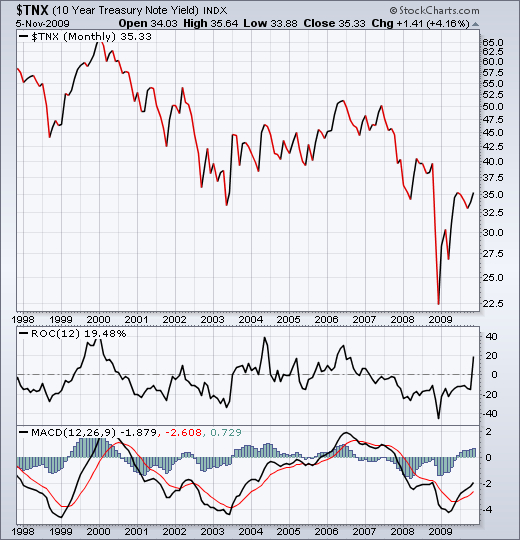
The yield of ten-year US Treasury Notes has surged by 34 basis points since the middle of October as market participants started adopting a more upbeat outlook on the economy and shied away from safe-haven assets.

Unsurprisingly, the following comes from the minutes of the meeting of November 4 of the Treasury Borrowing Advisory Committee of the Securities Industry and Financial Markets Association:

Several members noted the graph discussing net fixed income supply in 2009 and 2010, and how issuance will ramp up dramatically in 2010. Federal Reserve purchases have taken an enormous amount of supply out of the market this past year across fixed income markets, but next year, financial markets should expect even greater issuance with no support. Such an outcome could pressure rates.

With quantitative easing set to expire during Q1, it is difficult not to see long-term rates rising, unless the economy falls back into the morass.

Turning to technical analysis, the chart below (click to enlarge) shows monthly data for the ten-year Treasury Note yield since 1998 and conveys an important message when considering the two momentum-type oscillators at the bottom (ROC and MACD). The ROC has just reversed course (crossing the zero line) for the first time since a buy signal was given at the beginning of 2007 and now indicates a primary sell signal. The MACD provided a similar indication six months ago.
tnx

Source: StockCharts.com

(from seekingalpha.com, November 6, 2009)

Tuesday, August 11, 2009

Dollar's Hit a "Major Bottom," Prechter Says: Why That's Not Such Good News

by Peter Gorenstein in Newsmakers, Commodities

Forget all the talk about the dollar being in terminal decline. The recent rally in the greenback is for real, says Robert Prechter, president of Elliott Wave International. The man who correctly predicted the 1987 crash and last year's peak in oil prices now says we're "going to be up for a year or two in the dollar."

Reuters and other mainstream news outlets attribute the recent uptick in the dollar versus other major currencies to an improving economy signaled by Friday's "stronger-than-expected U.S. jobs numbers." Prechter, ever the contrarian, says the U.S. dollar has put in a major bottom but not for the reasons everyone else is pointing to.

Prechter points to three factors:

  • The Elliott Wave Pattern: Without getting too technical (for your sake and mine) Elliott Wave Theory looks at markets cycles in terms of wave structures that come in five parts. Five waves up followed by five waves down. Well, according to Prechter's research the pattern confirms we recently hit the fifth wave down. Next stop: up.
  • Sentiment has reached an extreme: "The Dollar Sentiment Index for the Dollar Index reports just 3% bulls among traders, an extreme level only five times in the past 20 years, usually near an important low," Prechter wrote on Aug. 5. "The last time we saw readings like this was March-July 2008, just before the dollar soared." In other words, the "short the dollar" trade is overly crowded.
  • The biggest risk to the economy is deflation not inflation: As he lays out in his book, Conquer the Crash, Prechter thinks the bursting of the latest bubble will lead to a major economic depression.
As we discuss in forthcoming segments, this good news for the dollar spells bad news for most other asset classes including stocks, commodities and real estate.